GRATUIT
Une maison remplie de meubles sains est tout comme La santé est aussi importante qu'une alimentation saine. De plus en plus de recherches mettent en évidence les dangers de certains produits chimiques toxiques et matériaux synthétiques utilisés dans la fabrication d'articles d'ameublement tels que les matelas et la literie.
Il y a milliers de produits chimiques potentiellement nocifs utilisés dans la fabrication de ces articles. Et il y a tout autant de termes marketing qui sont utilisés pour nous convaincre que nous faisons des choix sains et respectueux de l'environnement. Beaucoup de ces termes sont assez ambigus. Nous avons donc décidé de dresser une liste des mots les plus fréquemment utilisés sur les étiquettes et dans les publicités, afin de vous aider à devenir un acheteur avisé de produits d'ameublement de la maison.
Nous les voyons si souvent, mais savez-vous vraiment quelle est la différence entre naturel, entièrement naturel, biologique et certifié biologique ? Nous avons tout ce qu'il faut pour vous aider.
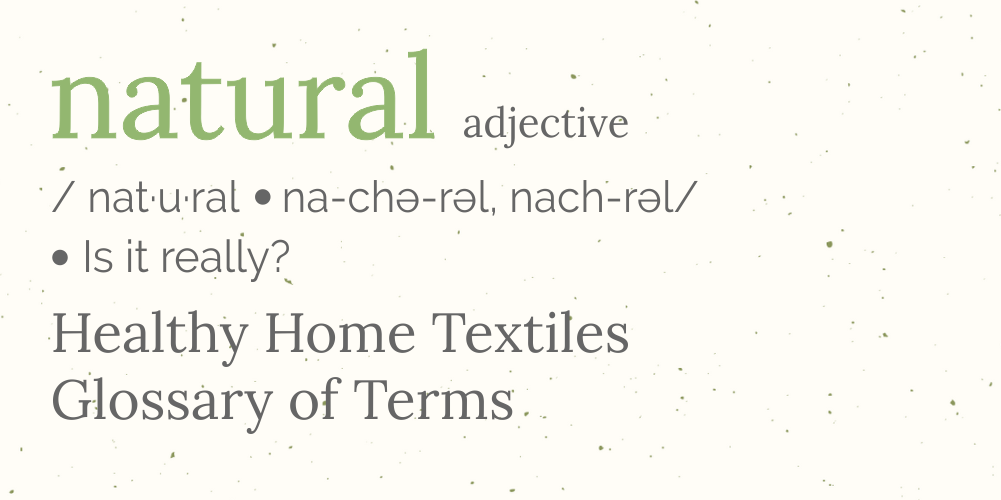
Glossaire des textiles d'intérieur sains
‘Naturel’
Ce mot figure souvent sur les étiquettes des produits alimentaires et ménagers. Nous l'associons à des matériaux trouvés ou cultivés dans la nature. Mais en fait, il n'y a pas d'exigences spécifiques pour l'utilisation de ce mot sur une étiquette. Il n'indique pas spécifiquement quels matériaux peuvent ou ne peuvent pas se trouver à l'intérieur de l'emballage, ni comment ces matériaux ‘naturels’ ont été traités lors de la création du produit final.
Aucun tissu ou matériau synthétique fabriqué par l'homme ne peut être qualifié de ‘naturel’, mais le produit final peut être étiqueté comme tel, même s'il contient des produits chimiques et synthétiques en plus des matériaux naturels.
Parmi les tissus et textiles artificiels, on peut citer la mousse, le nylon, le polyester, le chlorure de polyvinyle (PVC), l'élasthanne, la rayonne, l'acétate et l'acrylique.
‘Tout naturel’
Les produits ’entièrement naturels" sont ceux dont chaque ingrédient et composant est fabriqué à partir de matières naturelles et dont la composition ne contient pas de produits synthétiques. L'obtention d'un ‘entièrement naturel’ devrait vous donner l'assurance d'un choix plus sûr que les produits simplement étiquetés ‘naturels’.
‘Eco’
Également connu sous le nom de ‘respectueux de l'environnement’ ou ‘vert’. Ce terme fait référence à l'impact des produits ou matériaux et de leur processus de fabrication sur l'environnement.
Pour être considérés comme respectueux de l'environnement, ils doivent avoir un impact minimal ou nul sur l'environnement. Que ce soit lors de l'extraction, de l'approvisionnement, de la culture ou de la production. Et c'est là que les choses deviennent un peu floues car, une fois encore, il n'existe pas de définition claire de ce qui est acceptable en termes d'impact et de ce qui ne l'est pas.
‘Non toxique’
Ce terme n'est pas non plus réglementé. Il est principalement utilisé pour signifier l'absence, dans le produit fini (ou le matériau), de substances synthétiques ou chimiques ayant des effets toxiques sur la santé ou l'environnement. Malheureusement, selon les lignes directrices de la Consumer Product Safety Commission, tant que le produit tue moins de la moitié des rats de laboratoire lors des tests, il peut être étiqueté comme “non toxique”.
‘Sans toxines’
Produits créés sans utiliser d'ingrédients potentiellement toxiques, cancérigènes ou toxiques dont l'innocuité peut être mise en doute. Cela signifie qu'il peut toujours y avoir des produits chimiques à l'intérieur, mais pas ceux dont la toxicité a été prouvée.
‘Sans produits chimiques’
Ce terme est similaire à celui de "non toxique", mais il implique qu'aucun produit chimique n'a été utilisé. Il peut s'agir de toutes sortes de finitions, de teintures, de stabilisateurs, de produits chimiques anti-froissement, de produits ignifuges, etc.
‘Biologique’ et ‘certifié biologique’
Pour être biologiques, les produits doivent être cultivés dans un environnement qui n'a pas été traité avec des pesticides chimiques, des herbicides, des fongicides et des engrais artificiels. Les produits biologiques ne peuvent pas non plus être génétiquement modifiés.
Si un produit est étiqueté comme biologique sans être certifié comme tel, cela ne signifie pas qu'il n'est pas biologique en soi.
Si l'étiquette porte la mention ‘biologique’ et non ‘certifié biologique’, cela signifie que l'article n'a pas été testé de manière indépendante pour vérifier qu'il est conforme à un ensemble d'exigences normalisées du certificat biologique.
Souvent, les entreprises renoncent tout simplement à la certification en raison des coûts élevés qu'elle implique, même si leurs produits sont purs et conformes aux exigences requises pour obtenir la certification. Cette situation est particulièrement difficile pour les petites entreprises dont le budget est limité.
N'hésitez donc pas à contacter directement les entreprises et à leur poser vos questions pour vous assurer que vous obtenez un produit aussi pur que possible, même s'il n'y a pas de certification formelle.
Certificats populaires pour les textiles et l'ameublement
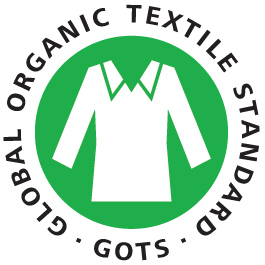
GOTS (Norme mondiale sur les textiles biologiques)
GOTS est l'une des certifications biologiques les plus reconnues, en particulier en Amérique du Nord. La norme couvre le traitement, la fabrication, l'emballage, l'étiquetage, le commerce et la distribution de tous les textiles. Elle évalue tous les produits chimiques utilisés dans les processus, afin de répondre aux exigences de base en matière de toxicité et de biodégradabilité/élimination, et n'autorise pas l'utilisation de métaux lourds toxiques, de formaldéhyde, de solvants aromatiques, de nanoparticules fonctionnelles, d'organismes génétiquement modifiés (OGM) et de leurs enzymes, ni le blanchiment au chlore, ni les teintures azoïques, ni les phtalates, ni le PVC.
Un produit textile portant le label GOTS dans la catégorie ‘biologique’ doit contenir un minimum de 95% de fibres biologiques certifiées, tandis qu'un produit portant la mention ‘fabriqué avec des fibres biologiques’ doit contenir un minimum de 70% de fibres biologiques certifiées.

USDA Organic
Ce certificat est délivré par le gouvernement américain. Il ne couvre que les fibres naturelles brutes utilisées pour fabriquer les textiles et les produits pour la maison, comme le coton, la laine et le lin. Ces fibres doivent être biologiques, c'est-à-dire qu'elles doivent répondre aux normes du National Organic Program. En revanche, il n'existe aucune réglementation concernant les autres ingrédients utilisés dans la fabrication des produits finis. Des colorants et des produits de finition toxiques peuvent donc encore être présents. Veillez à lire les petits caractères et à poser des questions aux entreprises pour clarifier tout ce que vous devez savoir avant d'acheter.
Norme Oeko-Tex 100
Oeko-Tex est l'une des normes les plus anciennes et les plus fiables qui existent. Bien que moins connue des clients hors d'Europe, lorsque vous la voyez sur un produit, vous pouvez être certain qu'il a été testé pour des centaines de produits chimiques et de substances nocives. Cela inclut les substances présentes dans le produit fini, mais aussi celles qui sont activées et deviennent nocives lors de l'utilisation normale du produit.
Elle exige une faible émission de composés organiques volatils (COV) et de formaldéhyde provenant de la mousse, tout en interdisant l'utilisation de certains retardateurs de flamme chimiques, colorants et teintures allergènes.
La norme Oeko-Tex Standard 100 comprend des réglementations concernant les colorants azoïques, le formaldéhyde, le nickel, etc. Les substances chimiques nocives pour la santé sont également testées si elles ne font pas encore l'objet d'une réglementation légale. Les exigences tiennent également compte de l'utilisation prévue des textiles. Plus le contact cutané d'un produit textile est intense, plus les valeurs limites pour chaque classe de produits sont strictes.
Classe de produits I : Articles pour bébés et enfants en bas âge
Classe de produits II : articles utilisés à proximité de la peau
Classe de produits III : articles utilisés loin de la peau
Classe de produits IV : Matériaux
Ce certificat est uniquement délivré par Oeko-Tex, qui garantit le respect des critères stricts susmentionnés, ce qui inspire confiance aux clients.
***
Chez Home of Wool, nous nous concentrons sur la fabrication de matelas en laine, de literie et d'articles de décoration intérieure sains pour vous et vos proches, à partir des matériaux les plus naturels et les plus purs qui soient, en utilisant uniquement de la laine, du lin, du coton et de la soie. Nous n'utilisons jamais de produits de finition, de retardateurs de flamme, de produits synthétiques ou de produits chimiques de quelque sorte que ce soit.
Quel que soit l'endroit où vous ferez vos prochains achats d'ameublement, nous vous conseillons toujours de commencer par vous renseigner sur les matériaux utilisés tout au long du processus de fabrication du produit. Cette petite étape, souvent négligée, vous aidera à déterminer si l'article est un choix sain pour votre maison et pour la planète.