

There are two people in the bed, but sometimes it feels like there is only one mattress. You move, the other person feels it. They turn, you wake up. Someone gets out of bed and suddenly the whole mattress seems to know about it. This is called motion transfer.
It may not be something you think about when buying a mattress. When you sleep alone, there is obviously nobody else to disturb. But once you share your bed, the way a mattress reacts to movement becomes much more important.
And especially if you and your partner have different sleeping habits, different body types, or simply very different ideas about what makes a mattress comfortable.
What is motion transfer?
In simple terms, motion transfer is how much movement travels through a mattress.
If your partner turns over on the other side of the bed, some mattresses will carry that movement across the surface. Others will absorb more of it around the area where the movement happens.
You may have experienced both.
On one mattress, your partner can get up without you even noticing. On another, getting in and out of bed feels like someone has moved the mattress underneath you.
There is no single reason why this happens. The materials inside the mattress matter, but so do its construction, firmness and size. The bed frame can make a difference as well. And, of course, two sleepers are never exactly the same.
A 50 kg sleeper who moves occasionally is going to create a very different situation from a 100 kg restless sleeper who changes position every few minutes.
So when we talk about mattress motion transfer, we are really talking about the entire sleeping setup.
What is motion isolation in a mattress?
Motion isolation is the other side of the same question. Instead of asking, “How much movement travels?”, we are asking, “How well does the mattress keep that movement in one area?”
A motion isolation mattress is designed to reduce the amount of movement that reaches the other sleeper.
That can be particularly useful for couples where one person wakes easily or gets up several times during the night.
A small 1999 study of mattress motion transfer involving 24 adults found that movement traveling across a mattress was associated with more light sleep and less deep sleep, although the number of awakenings did not significantly change.
Still, it is worth being realistic here. No mattress can promise that you will never feel your partner move. The result will always depend on the mattress itself, the frame, the sleepers and their sleeping habits.
A good mattress can reduce disturbance. But… it cannot make your partner disappear at 2 a.m.
Why mattress construction matters
The filling is only the beginning. How that filling is distributed, supported and secured can completely change the way a mattress responds to movement.
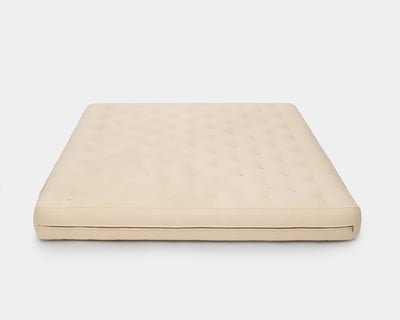
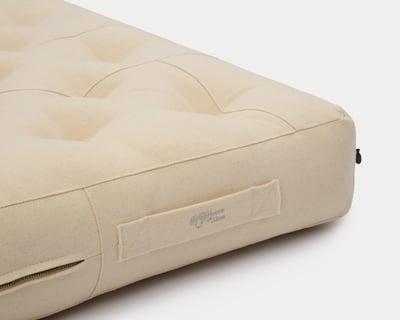
Our wool mattresses are made with a loose wool core, evenly distributed throughout the mattress and hand-tufted with strong, resilient linen threads. There are no synthetic foams or rigid layers between you and the wool. Instead, the wool remains springy and responsive, while the hand-tufting keeps the filling evenly in place and gives the mattress a stable, cohesive structure.
This construction is particularly well suited to a shared bed. When one person moves, the wool can compress and recover around their body rather than behaving like one rigid surface that carries every movement across the mattress.
In other words, the way the wool is built into the mattress matters just as much as the wool itself.
And this is where a well-made wool mattress can come remarkably close to an ideal balance for couples: supportive and responsive for each sleeper, while naturally helping to dampen the movement created by the other.
Of course, no mattress can promise that you will never feel your partner move. Body weight, sleeping habits, mattress size and the bed frame underneath all play a role. But with an evenly distributed wool core and traditional hand-tufting, we have found a construction that does an exceptionally good job of keeping the sleeping surface stable while allowing each sleeper to move comfortably.
Is a wool mattress good for couples?
It can be, especially when the mattress is constructed with the needs of two sleepers in mind.
Wool has qualities that make it naturally well suited to bedding. It is breathable, resilient and helps regulate moisture and temperature. These things matter when you are spending eight hours in the same sleeping environment with another person.
There is also the feel of the material itself.
Wool gives a mattress a certain softness without making it completely unresponsive. It can cushion the body while still providing support.
For couples, this can be a comfortable combination.
But again, the important word is construction.
The amount of wool, its arrangement, the firmness of the mattress and the way the mattress is made will all affect how it responds to movement. So there is no honest way to say that wool automatically means zero motion transfer. It does not.
What if one person likes a soft mattress and the other wants firm?
Now we get to a problem that has nothing to do with movement. You and your partner may simply disagree. You want something soft and cozy. Your partner wants a firm, supportive mattress. Or maybe you sleep on your side and need more cushioning, while they sleep on their back and feel better on something firmer.
Choosing one firmness for the entire bed means one of you is probably going to give something up. And this is where a different approach can make sense.
A mattress does not have to feel exactly the same on both sides
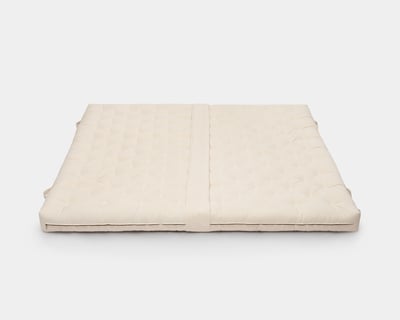
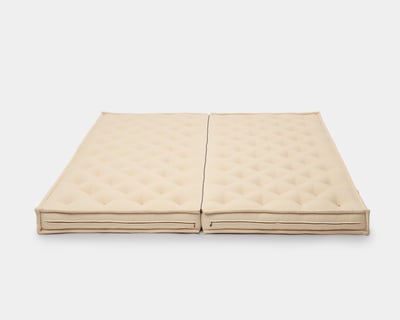
A split mattress for couples allows the two sides to be configured separately. That means you can choose the firmness that feels right for you, while your partner chooses theirs.
It is still one bed. It still looks and feels like a shared sleeping space. But underneath, the two sides do not have to be identical.
This can be particularly useful for couples with different body weights, sleeping positions or comfort preferences.
At Home of Wool, our split wool mattress is designed with this flexibility in mind. The two sides can be made with different firmnesses or thicknesses, so each sleeper can have a more personal sleeping surface.
It is a fairly simple idea. Why make two people compromise when you can make the mattress work for both?
Does a split mattress reduce motion transfer?
It can. When the mattress is divided into two independently constructed sections, movement created on one side has less of a continuous mattress surface through which to travel. This can be useful if one person moves considerably more than the other. But a split mattress is not a guarantee of complete motion isolation.
The construction of the two sections matters. So does how they are connected, what kind of bed frame supports them and how much each sleeper moves.
There is also something else to consider: the two sides may have different firmnesses or thicknesses. The bed needs to be designed accordingly so that the sleeping surface works as one comfortable whole.
The idea is not to create two completely separate beds. It is to give two people a little more independence while they are sharing one.
What should you look for in a mattress for restless sleepers?
If your partner is a restless sleeper, you probably already have your own definition of “motion transfer.” You wake up every time they turn. They pull the duvet. They get up. They come back. And somehow you are awake for all of it.
When choosing a mattress for restless sleepers, there are a few things worth looking at.
- Start with the construction. A mattress should respond to pressure without unnecessarily spreading that movement across the entire sleeping surface.
- Think about firmness. If the two sleepers need completely different levels of support, a split configuration may be worth considering.
- Look at the bed frame too. The mattress does not work independently from what is underneath it.
- Consider body weight and sleeping style. These affect how deeply each person compresses the mattress and how much movement is created.
- And most importantly, don’t judge a mattress only by its material. Two mattresses made with the same natural filling can behave differently.
The best mattress for couples may not be the same mattress for everyone
There is a reason mattress shopping as a couple can be surprisingly complicated. You are not choosing for one body. You are choosing for two. And those two bodies may have completely different requirements.
For some couples, the answer will be a single mattress with a shared firmness that works well for both. For others, individually selected firmness will make much more sense.
If one person sleeps lightly, motion transfer may become an important part of the decision. If both partners have similar sleeping habits, it may barely matter.
And if you are looking specifically for a colchón de lana for couples, don’t stop at the words “natural wool.” Look at how the mattress is actually constructed.
That is what determines how it supports you, how it responds when you move, and how much of that movement your partner is likely to feel.
Sharing a bed does not mean having identical sleeping preferences. One person can prefer soft. The other can prefer firm. One can sleep through almost anything. The other can wake up because the other person turned over three rooms away. There is no reason the mattress has to pretend these differences do not exist.
A thoughtfully designed sleeping system can take them into account. That may mean choosing a wool mattress with a firmness that works for both of you. Or it may mean going with a split mattress and giving each side its own feel. Either way, the goal is quite simple. Not to stop every movement. Not to promise a completely motionless night. Just to make it easier for two different sleepers to get the rest they need, in the same bed.
EXPLORE OUR WOOL MATTRESSES
-
Basta, Ropa de cama de lana BASTA Essential, Colchones de lana
Rango de precios: desde $578.00 hasta $1,462.00Rango de precios: desde $376.00 hasta $950.00 USD Seleccionar opciones Este producto tiene múltiples variantes. Las opciones se pueden elegir en la página de producto -
Precios a partir de El precio original era: $1,198.00.$958.00El precio actual es: $958.00. USD Seleccionar opciones
-

-